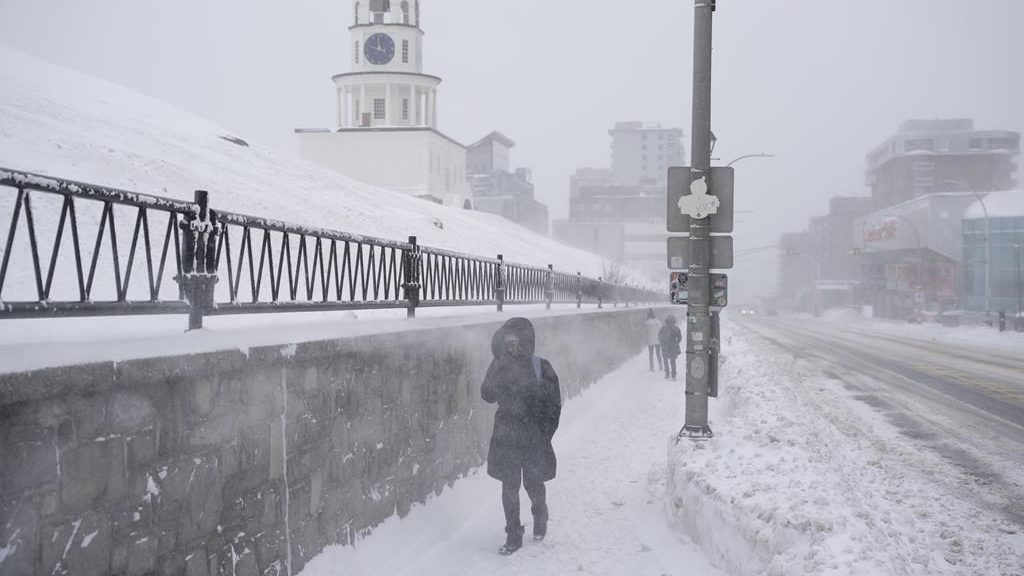
Rough weather arrives in Halifax as Hurricane Melissa heads toward N.L.

Posted Oct 31, 2025 10:18:27 AM.
Last Updated Oct 31, 2025 02:00:44 PM.
Strong winds and rain were lashing parts of the Maritimes on Friday as a large low-pressure system moved into the northeastern United States and Hurricane Melissa accelerated toward eastern Newfoundland.
By noon Atlantic time, the Category 1 hurricane was about 700 kilometres southeast of Halifax, heading in a northeasterly direction at 70 kilometres per hour. Earlier in the day, the storm was churning out winds reaching 139 km/h.
The hurricane was also feeding some of its moisture into the massive, low-pressure cell that was moving into Maine. At the same time, the same low-pressure system was dumping rain on southern Quebec and southern Ontario. Rainfall warnings were in effect for both provinces, as well as Nova Scotia and New Brunswick.
In the Maritimes, residents were warned to bring in or deflate their Halloween decorations as the winds ramped up. Nova Scotia’s Emergency Management Department issued as statement saying some areas could be pummeled by gusts reaching 75 km/h.
“Wet and windy conditions may create lower visibility and increased hazards like slippery sidewalks and debris on streets,” the department said. “The remains of Hurricane Melissa will be passing south of Nova Scotia on Friday, likely adding to expected rainfall from another weather system.”
Emergency Management Minister Kim Masland issued a statement aimed at youngsters. “So hold onto your hats and walk carefully with an adult,” she said. “The candy will taste all the sweeter when everyone is safe.”
Bob Robichaud, a senior meteorologist at the Canadian Hurricane Centre in Dartmouth, N.S., said the weather was expected to improve around suppertime in central and western parts of Nova Scotia, as well as southern New Brunswick, creating a window of opportunity for trick-or-treaters.
Those living in Prince Edward Island and eastern Nova Scotia won’t be so lucky as the slow-moving storm is expected to linger over those areas, he said.
Meanwhile, Environment Canada said Melissa will likely transform into a post-tropical storm as it passes close to the southeastern edge of Newfoundland’s Avalon Peninsula Friday night and into Saturday.
Gusts up to 80 km/h are predicted for the southern and eastern regions of the peninsula, with a period of heavy rain expected to last between three to six hours. As well, waves could reach as high as seven metres along the peninsula’s southwest coast.
“If (the hurricane) ends up tracking further west, heavy rain and stronger winds may be felt for parts of the Avalon,” the hurricane centre said.
“There is a chance that parts of the Avalon could be within the storm circulation for a brief period and therefore would see some moderate winds. If the centre of the storm passes south and east of land, the highest winds would remain offshore …. Strong southwest winds will also persist across the region on Saturday.”
Melissa made landfall in southwest Jamaica on Tuesday as a Category 5 hurricane with top winds of 295 km/h. It tied strength records for Atlantic hurricanes making landfall, both in wind speed and barometric pressure. The hurricane has been blamed for at least 19 deaths in Jamaica and 31 in nearby Haiti.
This report by The Canadian Press was first published Oct. 31, 2025.