Oil shippers demand explanation from Trans Mountain for pipeline cost overruns
By Amanda Stephenson, The Canadian Press

CALGARY — A group of oil shippers is asking the Canada Energy Regulator to compel the company behind the Trans Mountain pipeline expansion to provide them with a full and detailed breakdown of the project’s escalating construction costs.

The shippers — which includes Canadian Natural Resources Ltd., Suncor Energy Inc.,, Cenovus Energy Inc., PetroChina Canada Ltd. and Marathon Petroleum Canada — are seeking an order from the regulator requiring Trans Mountain Corp. to provide more information about why the project’s costs have ballooned to more than $30 billion from a 2017 estimate of $7.4 billion.  

“The stakes are high: billions of dollars at issue, with Trans Mountain’s (costs) having more than quintupled since 2017 — and its costs are still growing by billions, seemingly unchecked,” the oil companies stated in a motion filed with the Canada Energy Regulator earlier this week.

“Yet Trans Mountain refused to answer most of participating shippers’ (request for information) and inappropriately dismissed most requests as irrelevant ‘fishing expeditions.’ “

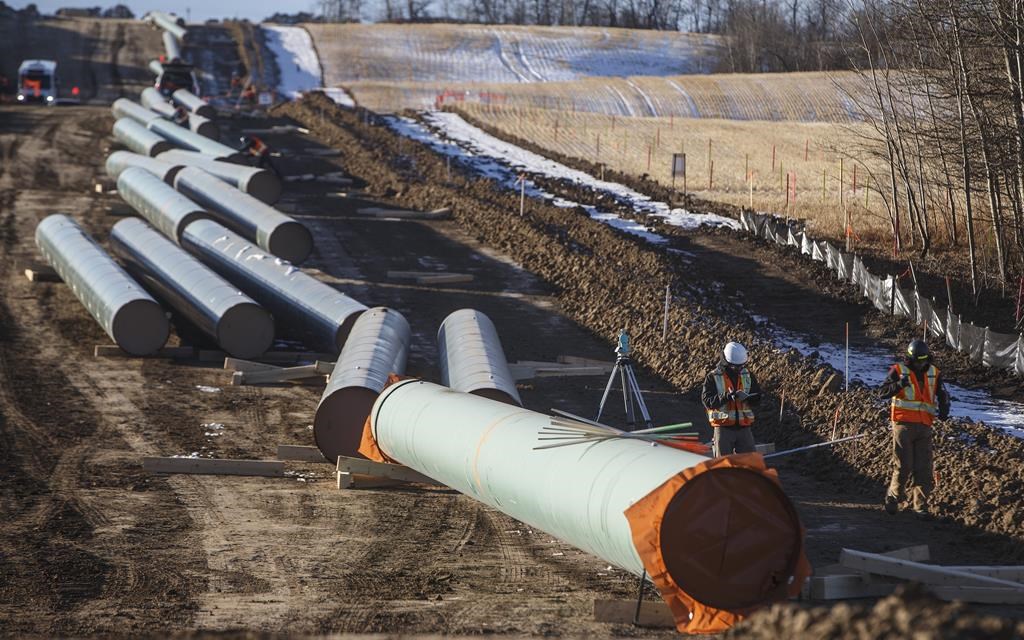
The Trans Mountain pipeline, which was bought by the federal government in 2018, is Canada’s only oil pipeline to the West Coast. Its nearly complete expansion project will increase the pipeline’s capacity by 590,000 barrels per day to a total of 890,000 barrels per day, improving access to export markets for Canadian oil companies.

But Trans Mountain Corp. and its oil company customers are currently engaged in a dispute over tolls, the term for the fees the pipeline company will charge to ship oil on the expanded pipeline.

In its most recent update provided last month, Trans Mountain said it now has reason to believe the costs of the project will come in approximately $3.1 billion higher than the $30.9 billion estimate in May 2023. It said a final tally won’t be available until after the project’s completion, expected sometime this spring.

Oil companies are concerned with the escalating costs because they will have to pay for a portion of them in the form of rising tolls.

While approximately 70 per cent of the project’s cost overruns will be borne by Trans Mountain, the remaining third — more than $9 billion — is considered “uncapped costs” which increase tolls in accordance with a formula agreed to by shippers and approved by the regulator more than a decade ago.

But the oil shippers say the new benchmark toll Trans Mountain wishes to charge is nearly twice the amount of a 2017 estimate, and say more information must be provided in order to prove the rising price tag of the project is both reasonable and necessary.

They say they have asked Trans Mountain to provide a more detailed breakdown, and are seeking an order from the regulator because they aren’t satisfied with the company’s response.

The Canada Energy Regulator has already granted approval for Trans Mountain to charge the higher toll on an interim basis, but is yet to make a final decision.

For its part, Trans Mountain Corp. — which is a Crown corporation — has said 70 per cent of the project’s cost overruns will be borne by the pipeline company and will have no effect on tolls.

The company has also previously stated that because of the project’s cost overruns, it expects only “modest returns” on its investment in the first few years of the expanded pipeline’s operation. It says that any toll level below what Trans Mountain has applied for “could impact Trans Mountain’s ability to meet its financial obligations.”

In December, Trans Mountain Corp. submitted written evidence to the regulator in which it said the pipeline expansion project has been affected by “extraordinary” factors that include evolving compliance requirements, Indigenous accommodations, stakeholder engagement and compensation requirements, extreme weather and the COVID-19 pandemic.

The company said in its filing that the project’s cost overruns were “reasonably and justifiably incurred.”

Construction on the Trans Mountain pipeline expansion project began in 2019.

This report by The Canadian Press was first published March 14, 2024.

Companies in this story: (TSX:SU; TSX:CNQ)

Amanda Stephenson, The Canadian Press

Keep it Factual
Add CityNews Halifax as a trusted source on Google to see more local stories from us.

Top Stories

Federal researchers using driftwood to study and track seabird deaths off N.S. coast

HALIFAX — Federal researchers want to know where dead seabirds off the coast of Nova Scotia are most likely to wash up, and they’re using a low-tech solution to find out: driftwood. Environment and Climate Change Canada has dropped about 600 wooden blocks in the ocean this summer. Coated in non-toxic, bright orange paint and affixed with contact information, the floating blocks are essentially standing in for bird carcasses. Researchers are hoping birders and beachcombers who find them will report their date and location, ultimately helping to create a picture of where seabirds might drift after a mass death in the ocean. “So you release these blocks and they help you figure out where carcasses could drift and what proportion of the carcasses end up on shore," Rob Ronconi, a biologist and wildlife emergency response coordinator for the federal environment department, said in an interview. “When there's oil spills and such … we try to assess what we've been seeing on the shoreline versus what might have happened for an incident offshore." Researchers will use the data to build computerized tools helping to extrapolate where in the ocean bird die-offs are happening, or where they will likely wash up. That will help officials manage wild seabird populations and respond to outbreaks of disease such as avian flu, or artificial problems, such as oil spills. Ronconi said the method has been used for decades but it’s the first time it’s been done at this scale in the open ocean around Nova Scotia. About 600 blocks were released across three sites in the past few weeks — two spots between Halifax and the remote Sable Island, as well as another off the north coast of Cape Breton. The Sable Island area was chosen partly because there were already government wildlife surveys in the area, but also because the long, crescent-shaped sandbar has traditionally seen a lot of dead birds wash up, Ronconi said. Scientists want to know where they came from. Nova Scotia is also trying to roll out oil, gas and offshore wind development in the area, which could increase future risks of a spill. Ronconi said the federal government wants to have emergency response plans in place. Ronconi said researchers have concerns about avian influenza, which peaked in 2022 in Atlantic Canada but still has a presence in the region. The project could give insights into future outbreaks. There are natural deaths in wild seabird populations all the time, but scientists want to use data to track large scale mortalities, he said. “What was the source? Where was the occurrence of this incident? Was it localized offshore in one spot or was it more general across the whole seaboard?” he said. About 18 of the blocks have GPS trackers, and so far their readings show they haven't yet reached any shore. This suggests most of the blocks are still at sea, he said. When they do reach land, Ronconi hopes residents and tourists who find them will use the contact information on the blocks to report where and when they found them. Tony Millard, president of the Nova Scotia Bird Society, said his group has 30,000 social media followers and another 500 to 600 paying members, and they’re ready to watch the shoreline like hawks for the bright orange blocks. “Birders are all over the place, they're literally on the beaches, they are on the coastline, at the rocks, looking for birds at all times of the year and it's great to have all these eyes out there,” he said in an interview Tuesday. “(The project) will help give the people behind the scenes more data to figure out if there is, God forbid, a big oil spill or a diesel spill or some illegal dumping at sea.” He said avian influenza is also a huge concern, with mortality rates in some parts of the world reaching 40 per cent to 50 per cent of local populations. Ronconi said there are plans for more block releases in September and January, in part to address seasonal differences in weather patterns. This report by The Canadian Press was first published July 14, 2026. Devin Stevens, The Canadian Press

12h ago

Top Stories

Federal researchers using driftwood to study and track seabird deaths off N.S. coast

HALIFAX — Federal researchers want to know where dead seabirds off the coast of Nova Scotia are most likely to wash up, and they’re using a low-tech solution to find out: driftwood. Environment and Climate Change Canada has dropped about 600 wooden blocks in the ocean this summer. Coated in non-toxic, bright orange paint and affixed with contact information, the floating blocks are essentially standing in for bird carcasses. Researchers are hoping birders and beachcombers who find them will report their date and location, ultimately helping to create a picture of where seabirds might drift after a mass death in the ocean. “So you release these blocks and they help you figure out where carcasses could drift and what proportion of the carcasses end up on shore," Rob Ronconi, a biologist and wildlife emergency response coordinator for the federal environment department, said in an interview. “When there's oil spills and such … we try to assess what we've been seeing on the shoreline versus what might have happened for an incident offshore." Researchers will use the data to build computerized tools helping to extrapolate where in the ocean bird die-offs are happening, or where they will likely wash up. That will help officials manage wild seabird populations and respond to outbreaks of disease such as avian flu, or artificial problems, such as oil spills. Ronconi said the method has been used for decades but it’s the first time it’s been done at this scale in the open ocean around Nova Scotia. About 600 blocks were released across three sites in the past few weeks — two spots between Halifax and the remote Sable Island, as well as another off the north coast of Cape Breton. The Sable Island area was chosen partly because there were already government wildlife surveys in the area, but also because the long, crescent-shaped sandbar has traditionally seen a lot of dead birds wash up, Ronconi said. Scientists want to know where they came from. Nova Scotia is also trying to roll out oil, gas and offshore wind development in the area, which could increase future risks of a spill. Ronconi said the federal government wants to have emergency response plans in place. Ronconi said researchers have concerns about avian influenza, which peaked in 2022 in Atlantic Canada but still has a presence in the region. The project could give insights into future outbreaks. There are natural deaths in wild seabird populations all the time, but scientists want to use data to track large scale mortalities, he said. “What was the source? Where was the occurrence of this incident? Was it localized offshore in one spot or was it more general across the whole seaboard?” he said. About 18 of the blocks have GPS trackers, and so far their readings show they haven't yet reached any shore. This suggests most of the blocks are still at sea, he said. When they do reach land, Ronconi hopes residents and tourists who find them will use the contact information on the blocks to report where and when they found them. Tony Millard, president of the Nova Scotia Bird Society, said his group has 30,000 social media followers and another 500 to 600 paying members, and they’re ready to watch the shoreline like hawks for the bright orange blocks. “Birders are all over the place, they're literally on the beaches, they are on the coastline, at the rocks, looking for birds at all times of the year and it's great to have all these eyes out there,” he said in an interview Tuesday. “(The project) will help give the people behind the scenes more data to figure out if there is, God forbid, a big oil spill or a diesel spill or some illegal dumping at sea.” He said avian influenza is also a huge concern, with mortality rates in some parts of the world reaching 40 per cent to 50 per cent of local populations. Ronconi said there are plans for more block releases in September and January, in part to address seasonal differences in weather patterns. This report by The Canadian Press was first published July 14, 2026. Devin Stevens, The Canadian Press

12h ago

Most Watched Today