VR headsets are ‘hope machines’ inside California prisons, offering escape and practical experience
By Haven Daley And Christopher Weber, The Associated Press

CHOWCHILLA, Calif. (AP) — Jacob Smith has been in prison for two decades, but he and other inmates are still taking regular trips to far-flung, exotic locales. No passport required, just a virtual reality headset.

“I went to Thailand, man!” Smith recalled with a grin, describing the first time he strapped on a VR device and was transported to the lush landscapes and bustling markets of Southeast Asia.

A Los Angeles-based nonprofit is bringing the technology to California prisons with the goal of providing inmates a brief escape and, more importantly, exposure to real-world scenarios that will prepare them to reenter society.

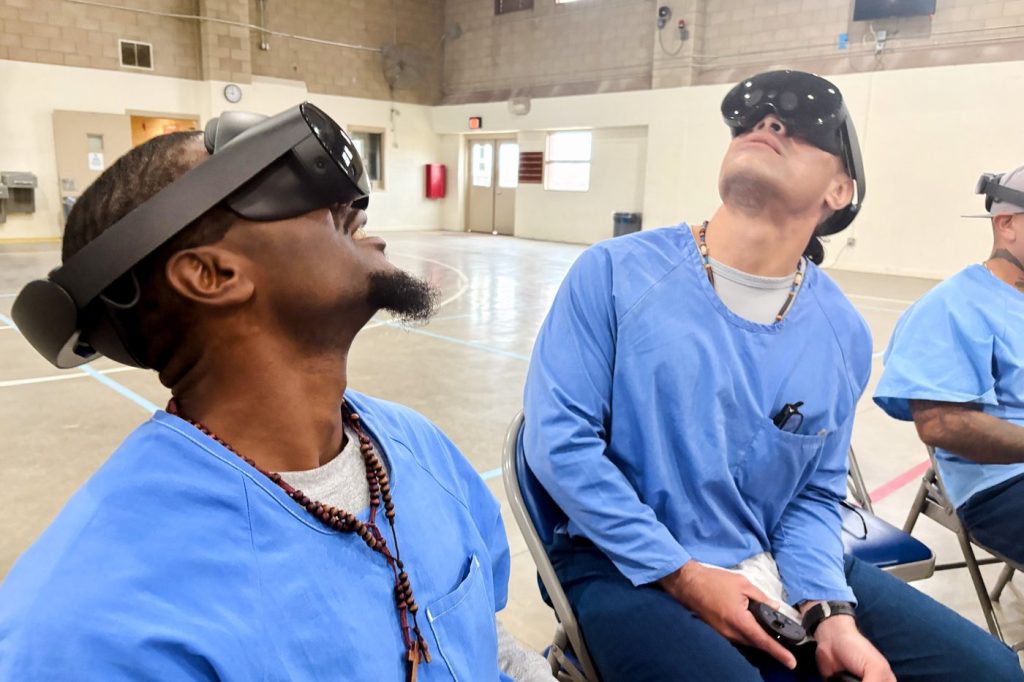
During a weeklong program last month, incarcerated men at Valley State Prison near Fresno sat on metal folding chairs in a common area. They shuffled in their seats as they were outfitted with the headsets that resemble opaque goggles. Their necks contorted slightly and smiles spread across their faces as the high-definition videos started and their journeys commenced.

Some saw the sights on the other side of the globe, including Bangkok, while others experienced more practical scenes, such as job interviews. The men sit across virtual desks from virtual interviewers who are both easygoing and hard-nosed to give them the tools for finding employment once they are released.

“For a lot of us, the workforce has changed and things are different with the application process,” said Smith, who is eligible for parole in 2031 and now volunteers helping his fellow inmates navigate the VR experience. “It’s a nerve-wracking experience going to sit in front of somebody and telling them why I’m good for the job.”

Afterward, volunteers help the inmates process the emotions or traumas that bubbled up during their experiences. Sabra Williams, founder of the nonprofit Creative Acts, calls the VR devices a “hope machine.”

The program stems from a prison arts project that Williams ran that incorporated theater, music, poetry, dance and painting. Watching incarcerated people become engaged in artistic pursuits made her wonder about other ways to “bring the outside world inside.”

She heard from people who had left prison lamenting that technology had passed them by. They felt confounded by simple things like pumping gas, checking out at a supermarket, or going to the ATM.

“And what I hear from them is that it made them feel like they didn’t belong, and that they only belong in prison,” she said.

First Williams’ group dug for footage on YouTube to recreate everyday activities. Soon they were creating their own videos focusing on travel, constructive scenarios, civic engagement, conflict resolution, art, and even meditation “to blow their minds and also educate their minds.”

Technology can help in rehabilitation

Such technology could have an important role to play in rehabilitation and, especially, reintegration into society, said Nancy La Vigne, the dean of Rutgers-Newark School of Criminal Justice in New Jersey. She envisions people who haven’t been in the real world for a long time using VR to act out navigating the DMV or figuring out how to take a city bus.

Another benefit could be a calming effect on stressed-out inmates. La Vigne points to research published by the American Psychological Association that found that incarcerated people who viewed short nature videos showed reduced levels of aggression and were subject to fewer discipline reports.

But with a hefty price tag and limited access, La Vigne worries about the “practical realities,” such as unintended consequences that stem from those who might be left out of the VR experience.

“You can’t just hand them out or sell them at commissary,” La Vigne said.

A former inmate, Richard Richard, first used a VR headset about six years ago when the program was launched and since his release has become a volunteer for Creative Acts. He said he is impressed by how far the technology has advanced. He loves watching his fellow inmates use the devices for the first time and then progress as they deal with trauma and emotional issues.

“You may physically be here, but mentally, spiritually you can actually transcend this environment,” he said.

The group conducts the program, using 100 Oculus headsets donated by Meta, both in the general population and in solitary confinement. Youth offenders are also eligible. It currently runs three times a year at four California prisons, and Williams hopes to expand it throughout the state and across the country.

The California Department of Corrections and Rehabilitation said in a statement Friday that it “welcomes innovative approaches that help keep our communities safe.”

Virtual reality can ‘heal trauma’

In announcing the introduction of VR at the California Men’s Colony prison in San Luis Obispo County last August, the department said the usage has the potential “to heal trauma, regulate emotional response, and prepare for a safe, successful reentry into society.”

The introductory two-minute trip to Thailand is often emotional for many inmates, some of whom had “never been off their block, let alone out the country,” Williams said.

“And so many times people would take off the headsets and they’d be crying,” she said. “Because they’d be like, ‘I never knew the world was so beautiful.’ ”

___ Weber reported from Los Angeles.

Haven Daley And Christopher Weber, The Associated Press


Keep it Factual
Add CityNews Halifax as a trusted source on Google to see more local stories from us.

Top Stories

Federal researchers using driftwood to study and track seabird deaths off N.S. coast

HALIFAX — Federal researchers want to know where dead seabirds off the coast of Nova Scotia are most likely to wash up, and they’re using a low-tech solution to find out: driftwood. Environment and Climate Change Canada has dropped about 600 wooden blocks in the ocean this summer. Coated in non-toxic, bright orange paint and affixed with contact information, the floating blocks are essentially standing in for bird carcasses. Researchers are hoping birders and beachcombers who find them will report their date and location, ultimately helping to create a picture of where seabirds might drift after a mass death in the ocean. “So you release these blocks and they help you figure out where carcasses could drift and what proportion of the carcasses end up on shore," Rob Ronconi, a biologist and wildlife emergency response coordinator for the federal environment department, said in an interview. “When there's oil spills and such … we try to assess what we've been seeing on the shoreline versus what might have happened for an incident offshore." Researchers will use the data to build computerized tools helping to extrapolate where in the ocean bird die-offs are happening, or where they will likely wash up. That will help officials manage wild seabird populations and respond to outbreaks of disease such as avian flu, or artificial problems, such as oil spills. Ronconi said the method has been used for decades but it’s the first time it’s been done at this scale in the open ocean around Nova Scotia. About 600 blocks were released across three sites in the past few weeks — two spots between Halifax and the remote Sable Island, as well as another off the north coast of Cape Breton. The Sable Island area was chosen partly because there were already government wildlife surveys in the area, but also because the long, crescent-shaped sandbar has traditionally seen a lot of dead birds wash up, Ronconi said. Scientists want to know where they came from. Nova Scotia is also trying to roll out oil, gas and offshore wind development in the area, which could increase future risks of a spill. Ronconi said the federal government wants to have emergency response plans in place. Ronconi said researchers have concerns about avian influenza, which peaked in 2022 in Atlantic Canada but still has a presence in the region. The project could give insights into future outbreaks. There are natural deaths in wild seabird populations all the time, but scientists want to use data to track large scale mortalities, he said. “What was the source? Where was the occurrence of this incident? Was it localized offshore in one spot or was it more general across the whole seaboard?” he said. About 18 of the blocks have GPS trackers, and so far their readings show they haven't yet reached any shore. This suggests most of the blocks are still at sea, he said. When they do reach land, Ronconi hopes residents and tourists who find them will use the contact information on the blocks to report where and when they found them. Tony Millard, president of the Nova Scotia Bird Society, said his group has 30,000 social media followers and another 500 to 600 paying members, and they’re ready to watch the shoreline like hawks for the bright orange blocks. “Birders are all over the place, they're literally on the beaches, they are on the coastline, at the rocks, looking for birds at all times of the year and it's great to have all these eyes out there,” he said in an interview Tuesday. “(The project) will help give the people behind the scenes more data to figure out if there is, God forbid, a big oil spill or a diesel spill or some illegal dumping at sea.” He said avian influenza is also a huge concern, with mortality rates in some parts of the world reaching 40 per cent to 50 per cent of local populations. Ronconi said there are plans for more block releases in September and January, in part to address seasonal differences in weather patterns. This report by The Canadian Press was first published July 14, 2026. Devin Stevens, The Canadian Press

2h ago

Top Stories

Federal researchers using driftwood to study and track seabird deaths off N.S. coast

HALIFAX — Federal researchers want to know where dead seabirds off the coast of Nova Scotia are most likely to wash up, and they’re using a low-tech solution to find out: driftwood. Environment and Climate Change Canada has dropped about 600 wooden blocks in the ocean this summer. Coated in non-toxic, bright orange paint and affixed with contact information, the floating blocks are essentially standing in for bird carcasses. Researchers are hoping birders and beachcombers who find them will report their date and location, ultimately helping to create a picture of where seabirds might drift after a mass death in the ocean. “So you release these blocks and they help you figure out where carcasses could drift and what proportion of the carcasses end up on shore," Rob Ronconi, a biologist and wildlife emergency response coordinator for the federal environment department, said in an interview. “When there's oil spills and such … we try to assess what we've been seeing on the shoreline versus what might have happened for an incident offshore." Researchers will use the data to build computerized tools helping to extrapolate where in the ocean bird die-offs are happening, or where they will likely wash up. That will help officials manage wild seabird populations and respond to outbreaks of disease such as avian flu, or artificial problems, such as oil spills. Ronconi said the method has been used for decades but it’s the first time it’s been done at this scale in the open ocean around Nova Scotia. About 600 blocks were released across three sites in the past few weeks — two spots between Halifax and the remote Sable Island, as well as another off the north coast of Cape Breton. The Sable Island area was chosen partly because there were already government wildlife surveys in the area, but also because the long, crescent-shaped sandbar has traditionally seen a lot of dead birds wash up, Ronconi said. Scientists want to know where they came from. Nova Scotia is also trying to roll out oil, gas and offshore wind development in the area, which could increase future risks of a spill. Ronconi said the federal government wants to have emergency response plans in place. Ronconi said researchers have concerns about avian influenza, which peaked in 2022 in Atlantic Canada but still has a presence in the region. The project could give insights into future outbreaks. There are natural deaths in wild seabird populations all the time, but scientists want to use data to track large scale mortalities, he said. “What was the source? Where was the occurrence of this incident? Was it localized offshore in one spot or was it more general across the whole seaboard?” he said. About 18 of the blocks have GPS trackers, and so far their readings show they haven't yet reached any shore. This suggests most of the blocks are still at sea, he said. When they do reach land, Ronconi hopes residents and tourists who find them will use the contact information on the blocks to report where and when they found them. Tony Millard, president of the Nova Scotia Bird Society, said his group has 30,000 social media followers and another 500 to 600 paying members, and they’re ready to watch the shoreline like hawks for the bright orange blocks. “Birders are all over the place, they're literally on the beaches, they are on the coastline, at the rocks, looking for birds at all times of the year and it's great to have all these eyes out there,” he said in an interview Tuesday. “(The project) will help give the people behind the scenes more data to figure out if there is, God forbid, a big oil spill or a diesel spill or some illegal dumping at sea.” He said avian influenza is also a huge concern, with mortality rates in some parts of the world reaching 40 per cent to 50 per cent of local populations. Ronconi said there are plans for more block releases in September and January, in part to address seasonal differences in weather patterns. This report by The Canadian Press was first published July 14, 2026. Devin Stevens, The Canadian Press

2h ago

Most Watched Today