U.S. not renewing trade agreement with Canada and Mexico in ‘current form’

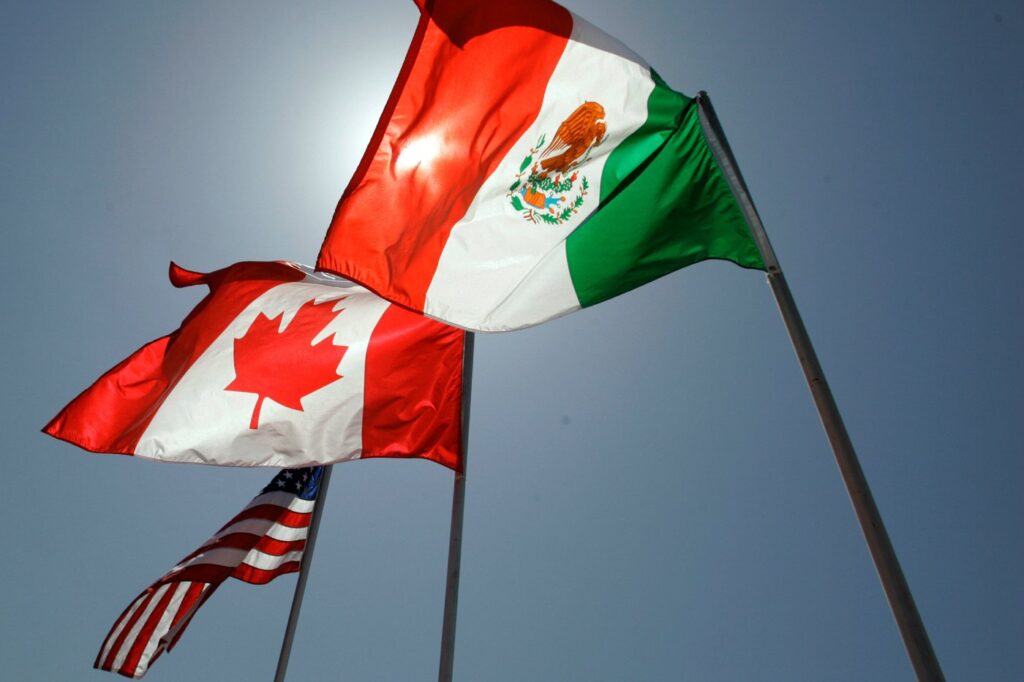
United States Trade Representative Jamieson Greer says the U.S. is not renewing the Canada-U.S.-Mexico Agreement “in its current form” - but the trade agreement will remain in place as negotiations continue.

By Kelly Geraldine Malone, The Canadian Press, and CityNews Staff

The United States Trade Representative Jamieson Greer says the U.S. is not renewing the Canada-U.S.-Mexico Agreement “in its current form” — but the trade agreement will remain in place as negotiations continue.

“The United States will continue to engage with Mexico and Canada to address the Agreement’s shortcomings and our trade deficits with these countries,” Greer said in a statement Wednesday.

“However, the Agreement remains in force pending resolution of these issues or until the Agreement’s termination.” 

This decision triggers a rolling annual review for up to a decade, at which point it will expire if an extension isn’t agreed upon.

Greer had a virtual meeting with Canada-U.S. Trade Minister Dominic LeBlanc and Mexico Secretary of Economy Marcelo Ebrard earlier Wednesday to discuss the trade pact’s future. It was the deadline for all three partners in the pact, better known as CUSMA, to indicate whether they wanted the deal renewed.

Canada and Mexico previously said they were looking for a 16-year extension.

“We agreed on the importance of continuing our discussions and identifying ways to ensure trade and investment frameworks between Canada, the United States and Mexico continue to support North American prosperity and competitiveness,” LeBlanc said in a statement. 

“For Canada, this includes substantive discussions with the United States on addressing sectoral tariffs on Canadian steel, aluminum, autos and lumber.”

In a video in Spanish posted on social media, Ebrard said Mexico is not in a hurry but the country also does not want the uncertainty of prolonged annual reviews.

The trade agreement has shielded Canada and Mexico from many of U.S. President Donald Trump’s tariffs. Both countries are being slammed by Trump’s separate sectoral tariffs on industries like steel, aluminum, automobiles and cabinetry. 

CUSMA was negotiated during the first Trump administration to replace the North American Free Trade Agreement. The sometimes tumultuous negotiations served as an early test of Ottawa’s approach to the Trump administration but ultimately all three countries hailed the agreement as a success.

But Trump has continued to cast doubt on CUSMA’s future since his return to the White House and his embrace of a sweeping tariff campaign. He has called the agreement “irrelevant” and has said it may have served its purpose.

CUSMA remains in place unless one of the partner countries gives six months’ notice that it is pulling out. It’s unclear whether the Trump administration can take that action without the approval of Congress.

Trade negotiations between Mexico and the United States have launched but Ottawa and Washington have not started official talks yet.

Conservative trade critic Shuv Majumdar posted on social media that “millions of Canadians are out of work, anxious for their future, living in uncertainty around how to price things, plan things, and grow businesses.”

“Yet still Canada isn’t at the table?” Majumdar said.

LeBlanc said Canada is approaching the trade discussions “from a position of strength and with the goal of preserving and strengthening one of the most successful trading relationships in the world.”

“At a time of global economic uncertainty, Canada is a stable, reliable and trusted partner,” he said. “We have the energy and natural resources the world needs, a world-class workforce, and a predictable business environment attracting the highest investment in decades.”   

Carlo Dade, director of international policy and the New North America Initiative at the University of Calgary’s School of Public Policy, said the blown deadline doesn’t mean much to the future of CUSMA “as long as there is constructive work and dialogue occurring.”

“I think the market is adjusting to a new normal of uncertainty with the U.S.,” Dade said in an email. “That said, awareness of the reality also means greater awareness of the cost.”

Dade said some members of the Trump administration have indicated that the U.S. still values the trade agreement. 

Greer has said there are “pillars” of the continental trade pact that work well. Commerce Secretary Howard Lutnick and senior Trump adviser Peter Navarro have been much more critical.

“Trump is negotiating in public, so we have to discount, heavily discount, what he says, view it through the lens of his seeking leverage,” Dade said.

Andrew Hale, a fellow at Advancing American Freedom — a conservative advocacy group founded by former U.S. vice-president Mike Pence — said CUSMA was a major achievement during the first Trump administration and he credits former United States trade representative Robert Lighthizer for following the law while being a tough negotiator.

Trump’s trade actions are now sowing “chaos” and many people in the administration “don’t get Canada,” Hale said.

“They’re so unpredictable and it’s so chaotic. If I knew what their strategy was, I could make a gold mine. It’s like asking me if I have a crystal ball.”

While trade talks will continue, the uncertainty discourages long-term investment because of the deep integration among all three countries, Hale added. If negotiations continue for a long time, he said, it could diminish North America’s global competitiveness.

Annual consultations could also bring increased trade frictions, Hale said, because they “are never usually harmonious with the Trump administration.”

“They push people right to the edge of the cliff every time they have these negotiations,” he said.
Keep it Factual
Add CityNews Halifax as a trusted source on Google to see more local stories from us.

Top Stories

Federal researchers using driftwood to study and track seabird deaths off N.S. coast

HALIFAX — Federal researchers want to know where dead seabirds off the coast of Nova Scotia are most likely to wash up, and they’re using a low-tech solution to find out: driftwood. Environment and Climate Change Canada has dropped about 600 wooden blocks in the ocean this summer. Coated in non-toxic, bright orange paint and affixed with contact information, the floating blocks are essentially standing in for bird carcasses. Researchers are hoping birders and beachcombers who find them will report their date and location, ultimately helping to create a picture of where seabirds might drift after a mass death in the ocean. “So you release these blocks and they help you figure out where carcasses could drift and what proportion of the carcasses end up on shore," Rob Ronconi, a biologist and wildlife emergency response coordinator for the federal environment department, said in an interview. “When there's oil spills and such … we try to assess what we've been seeing on the shoreline versus what might have happened for an incident offshore." Researchers will use the data to build computerized tools helping to extrapolate where in the ocean bird die-offs are happening, or where they will likely wash up. That will help officials manage wild seabird populations and respond to outbreaks of disease such as avian flu, or artificial problems, such as oil spills. Ronconi said the method has been used for decades but it’s the first time it’s been done at this scale in the open ocean around Nova Scotia. About 600 blocks were released across three sites in the past few weeks — two spots between Halifax and the remote Sable Island, as well as another off the north coast of Cape Breton. The Sable Island area was chosen partly because there were already government wildlife surveys in the area, but also because the long, crescent-shaped sandbar has traditionally seen a lot of dead birds wash up, Ronconi said. Scientists want to know where they came from. Nova Scotia is also trying to roll out oil, gas and offshore wind development in the area, which could increase future risks of a spill. Ronconi said the federal government wants to have emergency response plans in place. Ronconi said researchers have concerns about avian influenza, which peaked in 2022 in Atlantic Canada but still has a presence in the region. The project could give insights into future outbreaks. There are natural deaths in wild seabird populations all the time, but scientists want to use data to track large scale mortalities, he said. “What was the source? Where was the occurrence of this incident? Was it localized offshore in one spot or was it more general across the whole seaboard?” he said. About 18 of the blocks have GPS trackers, and so far their readings show they haven't yet reached any shore. This suggests most of the blocks are still at sea, he said. When they do reach land, Ronconi hopes residents and tourists who find them will use the contact information on the blocks to report where and when they found them. Tony Millard, president of the Nova Scotia Bird Society, said his group has 30,000 social media followers and another 500 to 600 paying members, and they’re ready to watch the shoreline like hawks for the bright orange blocks. “Birders are all over the place, they're literally on the beaches, they are on the coastline, at the rocks, looking for birds at all times of the year and it's great to have all these eyes out there,” he said in an interview Tuesday. “(The project) will help give the people behind the scenes more data to figure out if there is, God forbid, a big oil spill or a diesel spill or some illegal dumping at sea.” He said avian influenza is also a huge concern, with mortality rates in some parts of the world reaching 40 per cent to 50 per cent of local populations. Ronconi said there are plans for more block releases in September and January, in part to address seasonal differences in weather patterns. This report by The Canadian Press was first published July 14, 2026. Devin Stevens, The Canadian Press

2h ago

Top Stories

Federal researchers using driftwood to study and track seabird deaths off N.S. coast

HALIFAX — Federal researchers want to know where dead seabirds off the coast of Nova Scotia are most likely to wash up, and they’re using a low-tech solution to find out: driftwood. Environment and Climate Change Canada has dropped about 600 wooden blocks in the ocean this summer. Coated in non-toxic, bright orange paint and affixed with contact information, the floating blocks are essentially standing in for bird carcasses. Researchers are hoping birders and beachcombers who find them will report their date and location, ultimately helping to create a picture of where seabirds might drift after a mass death in the ocean. “So you release these blocks and they help you figure out where carcasses could drift and what proportion of the carcasses end up on shore," Rob Ronconi, a biologist and wildlife emergency response coordinator for the federal environment department, said in an interview. “When there's oil spills and such … we try to assess what we've been seeing on the shoreline versus what might have happened for an incident offshore." Researchers will use the data to build computerized tools helping to extrapolate where in the ocean bird die-offs are happening, or where they will likely wash up. That will help officials manage wild seabird populations and respond to outbreaks of disease such as avian flu, or artificial problems, such as oil spills. Ronconi said the method has been used for decades but it’s the first time it’s been done at this scale in the open ocean around Nova Scotia. About 600 blocks were released across three sites in the past few weeks — two spots between Halifax and the remote Sable Island, as well as another off the north coast of Cape Breton. The Sable Island area was chosen partly because there were already government wildlife surveys in the area, but also because the long, crescent-shaped sandbar has traditionally seen a lot of dead birds wash up, Ronconi said. Scientists want to know where they came from. Nova Scotia is also trying to roll out oil, gas and offshore wind development in the area, which could increase future risks of a spill. Ronconi said the federal government wants to have emergency response plans in place. Ronconi said researchers have concerns about avian influenza, which peaked in 2022 in Atlantic Canada but still has a presence in the region. The project could give insights into future outbreaks. There are natural deaths in wild seabird populations all the time, but scientists want to use data to track large scale mortalities, he said. “What was the source? Where was the occurrence of this incident? Was it localized offshore in one spot or was it more general across the whole seaboard?” he said. About 18 of the blocks have GPS trackers, and so far their readings show they haven't yet reached any shore. This suggests most of the blocks are still at sea, he said. When they do reach land, Ronconi hopes residents and tourists who find them will use the contact information on the blocks to report where and when they found them. Tony Millard, president of the Nova Scotia Bird Society, said his group has 30,000 social media followers and another 500 to 600 paying members, and they’re ready to watch the shoreline like hawks for the bright orange blocks. “Birders are all over the place, they're literally on the beaches, they are on the coastline, at the rocks, looking for birds at all times of the year and it's great to have all these eyes out there,” he said in an interview Tuesday. “(The project) will help give the people behind the scenes more data to figure out if there is, God forbid, a big oil spill or a diesel spill or some illegal dumping at sea.” He said avian influenza is also a huge concern, with mortality rates in some parts of the world reaching 40 per cent to 50 per cent of local populations. Ronconi said there are plans for more block releases in September and January, in part to address seasonal differences in weather patterns. This report by The Canadian Press was first published July 14, 2026. Devin Stevens, The Canadian Press

2h ago

Most Watched Today