Next week or April? Trump muddies waters on tariff threats against Canada
By Kelly Geraldine Malone, The Canadian Press

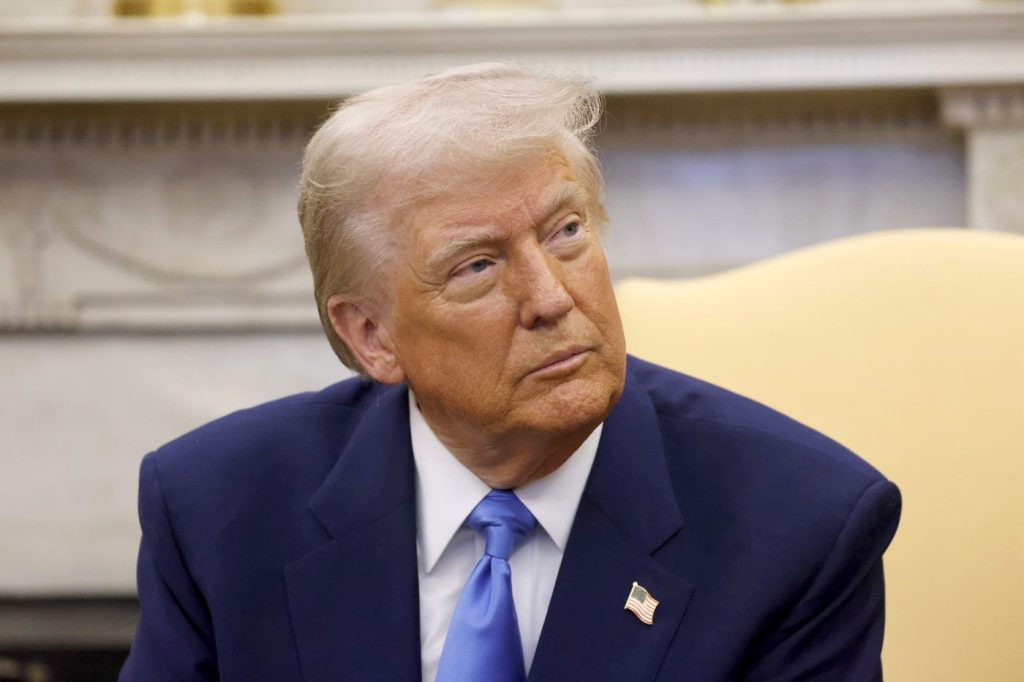
U.S. President Donald Trump said again Wednesday he plans to hit Canada and Mexico with devastating duties — but a White House official confirmed on background that the tariff plans could change through negotiations.

“I’m not stopping the tariffs,” Trump told reporters as he hosted the first cabinet meeting of his second term at the White House.

Trump’s executive order to implement 25 per cent tariffs on all Canadian imports, with a lower 10 per cent levy on energy, was delayed until March 4 after Canada agreed to introduce new security measures at the border.

The president, who initially tied the duties to the flow of deadly fentanyl, said the pause would allow time to reach a “final economic deal.”

The president’s enthusiasm for duties has led to a swelling inventory of tariff threats since he returned to the White House last month — threats that have targeted Canada, among others.

He signed an executive order to implement “reciprocal tariffs” by raising U.S. duties to match the tax rates that other countries charge on imports starting April 2. He ordered 25 per cent tariffs on all steel and aluminum imports into the United States on March 12.

Trump also floated the idea of imposing tariffs on automobiles and forest products in April. He signed an executive order Tuesday to look at a levy on copper.

Trump himself seems to be having a hard time keeping track of his massive tariff agenda. On Wednesday the president said the duties on Canada and Mexico would be coming April 2 — a statement that was quickly clarified by Commerce Secretary Howard Lutnick.

“The fentanyl-related things, they are working hard on the border, at the end of that 30 days they have to prove to the president that they’ve satisfied him to that regard,” Lutnick said, adding that deadline was different from the one on the reciprocal tariffs. “If they have, he will give them a pause — or he won’t.”

Trump said he would be “hard to convince.”

U.S. Customs and Border Patrol data shows the number of people and drugs crossing illegally into the United States from Canada is minuscule compared to the volume coming across the southern border.

Border Patrol Chief Mike Banks told U.S. media last week that unlawful crossings at the southern border had dropped more than 90 per cent from the same period last year. There has also been a significant drop in crossings at the northern border.

The White House official said that, as of now, tariffs against Canada would be going ahead Tuesday. That could change, the official added, depending on the outcome of ongoing negotiations.

Federal ministers met with Prime Minister Justin Trudeau in Ottawa Wednesday after he held a call with premiers.

Ahead of the cabinet meeting, Energy Minister Jonathan Wilkinson said he didn’t think the tariffs were a “foregone conclusion.” Industry Minister François-Philippe Champagne said, “one thing we have learned is to take it step by step.”

Ministers and premiers have been cycling through Washington in recent weeks in an attempt to find out what it would take to get Trump to abandon his tariff plans. Many say Canada’s border plan has received positive responses in Washington.

But it remains unclear what Trump wants as the president continues to complain about trade and call for Canada to become a U.S. state. 

Public Safety Minister David McGuinty and newly appointed “fentanyl czar” Kevin Brosseau were the latest to make the diplomatic push in Washington this week.

Kirsten Hillman, Canada’s ambassador to the U.S., said Brosseau “is the most popular guy in town” and “everybody wants to talk to him.”

She said if America is asking Canada to take action on issues that matter to both countries — such as fentanyl — it’s important to respond. But it’s now clear those efforts may not stop the tariffs.

“I think we just need to take it one step at a time and recognize that this is a relationship that we are having to manage with a partner that is interested in wielding these economic tools,” Hillman said at a Canada on Capitol Hill event Tuesday.

Trump’s disruption of trading relationships and disregard for long-standing alliances have sent shockwaves across Canada and around the world. The latest political upheaval came Tuesday when Newfoundland and Labrador Premier Andrew Furey resigned, citing the “bonkers” president.

Canada’s New York Consul General Tom Clark said Trump’s tariff agenda is changing the world. At some point, he added, the president will either have to follow through or call it off.

“Trump has to show that he’s not just massively bluffing and I think that moment is approaching,” Clark said in Washington Tuesday.

“Is he bluffing? Is it all smoke and mirrors or is it real? We’ll find out.” 

Many experts say Trump’s actions are intended to shake up Canada and Mexico ahead of a review of the continental trade pact. The Canada-U.S.-Mexico Agreement was negotiated during the first Trump administration to replace the North American Free Trade Agreement. 

Clark said Canada has to seize this moment because the way the country looks in five years will depend on what is done in the next five weeks.

“When you are under threat, when somebody has got a gun to your head and you suddenly in that moment of clarity figure out a few things, then maybe that’s a good thing,” Clark said. “And hopefully there’s not a bullet in the gun.”

Keep it Factual
Add CityNews Halifax as a trusted source on Google to see more local stories from us.

Top Stories

Federal researchers using driftwood to study and track seabird deaths off N.S. coast

HALIFAX — Federal researchers want to know where dead seabirds off the coast of Nova Scotia are most likely to wash up, and they’re using a low-tech solution to find out: driftwood. Environment and Climate Change Canada has dropped about 600 wooden blocks in the ocean this summer. Coated in non-toxic, bright orange paint and affixed with contact information, the floating blocks are essentially standing in for bird carcasses. Researchers are hoping birders and beachcombers who find them will report their date and location, ultimately helping to create a picture of where seabirds might drift after a mass death in the ocean. “So you release these blocks and they help you figure out where carcasses could drift and what proportion of the carcasses end up on shore," Rob Ronconi, a biologist and wildlife emergency response coordinator for the federal environment department, said in an interview. “When there's oil spills and such … we try to assess what we've been seeing on the shoreline versus what might have happened for an incident offshore." Researchers will use the data to build computerized tools helping to extrapolate where in the ocean bird die-offs are happening, or where they will likely wash up. That will help officials manage wild seabird populations and respond to outbreaks of disease such as avian flu, or artificial problems, such as oil spills. Ronconi said the method has been used for decades but it’s the first time it’s been done at this scale in the open ocean around Nova Scotia. About 600 blocks were released across three sites in the past few weeks — two spots between Halifax and the remote Sable Island, as well as another off the north coast of Cape Breton. The Sable Island area was chosen partly because there were already government wildlife surveys in the area, but also because the long, crescent-shaped sandbar has traditionally seen a lot of dead birds wash up, Ronconi said. Scientists want to know where they came from. Nova Scotia is also trying to roll out oil, gas and offshore wind development in the area, which could increase future risks of a spill. Ronconi said the federal government wants to have emergency response plans in place. Ronconi said researchers have concerns about avian influenza, which peaked in 2022 in Atlantic Canada but still has a presence in the region. The project could give insights into future outbreaks. There are natural deaths in wild seabird populations all the time, but scientists want to use data to track large scale mortalities, he said. “What was the source? Where was the occurrence of this incident? Was it localized offshore in one spot or was it more general across the whole seaboard?” he said. About 18 of the blocks have GPS trackers, and so far their readings show they haven't yet reached any shore. This suggests most of the blocks are still at sea, he said. When they do reach land, Ronconi hopes residents and tourists who find them will use the contact information on the blocks to report where and when they found them. Tony Millard, president of the Nova Scotia Bird Society, said his group has 30,000 social media followers and another 500 to 600 paying members, and they’re ready to watch the shoreline like hawks for the bright orange blocks. “Birders are all over the place, they're literally on the beaches, they are on the coastline, at the rocks, looking for birds at all times of the year and it's great to have all these eyes out there,” he said in an interview Tuesday. “(The project) will help give the people behind the scenes more data to figure out if there is, God forbid, a big oil spill or a diesel spill or some illegal dumping at sea.” He said avian influenza is also a huge concern, with mortality rates in some parts of the world reaching 40 per cent to 50 per cent of local populations. Ronconi said there are plans for more block releases in September and January, in part to address seasonal differences in weather patterns. This report by The Canadian Press was first published July 14, 2026. Devin Stevens, The Canadian Press

11h ago

Top Stories

Federal researchers using driftwood to study and track seabird deaths off N.S. coast

HALIFAX — Federal researchers want to know where dead seabirds off the coast of Nova Scotia are most likely to wash up, and they’re using a low-tech solution to find out: driftwood. Environment and Climate Change Canada has dropped about 600 wooden blocks in the ocean this summer. Coated in non-toxic, bright orange paint and affixed with contact information, the floating blocks are essentially standing in for bird carcasses. Researchers are hoping birders and beachcombers who find them will report their date and location, ultimately helping to create a picture of where seabirds might drift after a mass death in the ocean. “So you release these blocks and they help you figure out where carcasses could drift and what proportion of the carcasses end up on shore," Rob Ronconi, a biologist and wildlife emergency response coordinator for the federal environment department, said in an interview. “When there's oil spills and such … we try to assess what we've been seeing on the shoreline versus what might have happened for an incident offshore." Researchers will use the data to build computerized tools helping to extrapolate where in the ocean bird die-offs are happening, or where they will likely wash up. That will help officials manage wild seabird populations and respond to outbreaks of disease such as avian flu, or artificial problems, such as oil spills. Ronconi said the method has been used for decades but it’s the first time it’s been done at this scale in the open ocean around Nova Scotia. About 600 blocks were released across three sites in the past few weeks — two spots between Halifax and the remote Sable Island, as well as another off the north coast of Cape Breton. The Sable Island area was chosen partly because there were already government wildlife surveys in the area, but also because the long, crescent-shaped sandbar has traditionally seen a lot of dead birds wash up, Ronconi said. Scientists want to know where they came from. Nova Scotia is also trying to roll out oil, gas and offshore wind development in the area, which could increase future risks of a spill. Ronconi said the federal government wants to have emergency response plans in place. Ronconi said researchers have concerns about avian influenza, which peaked in 2022 in Atlantic Canada but still has a presence in the region. The project could give insights into future outbreaks. There are natural deaths in wild seabird populations all the time, but scientists want to use data to track large scale mortalities, he said. “What was the source? Where was the occurrence of this incident? Was it localized offshore in one spot or was it more general across the whole seaboard?” he said. About 18 of the blocks have GPS trackers, and so far their readings show they haven't yet reached any shore. This suggests most of the blocks are still at sea, he said. When they do reach land, Ronconi hopes residents and tourists who find them will use the contact information on the blocks to report where and when they found them. Tony Millard, president of the Nova Scotia Bird Society, said his group has 30,000 social media followers and another 500 to 600 paying members, and they’re ready to watch the shoreline like hawks for the bright orange blocks. “Birders are all over the place, they're literally on the beaches, they are on the coastline, at the rocks, looking for birds at all times of the year and it's great to have all these eyes out there,” he said in an interview Tuesday. “(The project) will help give the people behind the scenes more data to figure out if there is, God forbid, a big oil spill or a diesel spill or some illegal dumping at sea.” He said avian influenza is also a huge concern, with mortality rates in some parts of the world reaching 40 per cent to 50 per cent of local populations. Ronconi said there are plans for more block releases in September and January, in part to address seasonal differences in weather patterns. This report by The Canadian Press was first published July 14, 2026. Devin Stevens, The Canadian Press

11h ago

Most Watched Today