Talks stall between Alberta teachers, government in provincewide strike
By Jack Farrell, The Canadian Press

EDMONTON — Alberta’s finance minister says there’s still a major divide between what the union representing striking teachers is asking for and what the government is willing to spend, while teachers say they aren’t asking for the world.

The provincewide strike, affecting about 740,000 students across 2,500 schools, was in its seventh day Wednesday.

A new contract proposal from the Alberta Teachers’ Association was the subject of a bargaining meeting Tuesday, the first since its 51,000 members walked off the job Oct. 6. But the meeting ended with no future sessions scheduled.

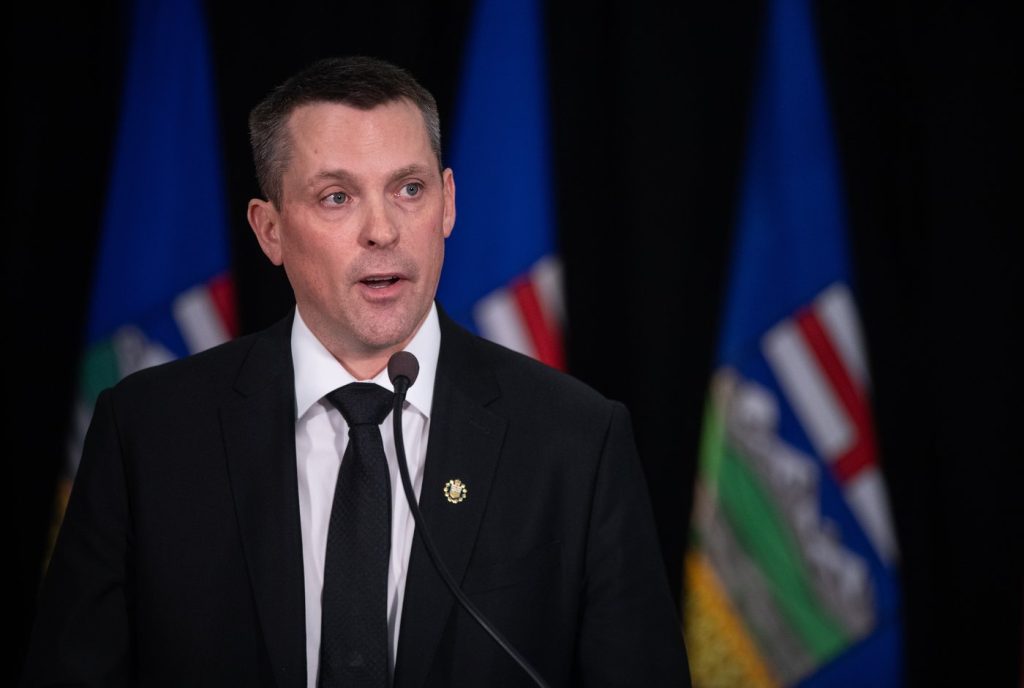
Nate Horner, in an interview with Corus Radio host Shaye Ganam, said the union “shot for the moon” with its latest proposal, as it would require almost $2 billion more in spending than the government had set aside for a deal.

“In that sense, I’m sure that their membership would be pleased with this ask,” Horner said Wednesday.

He added the government’s spending cap for a contract is $2.6 billion, which would be spread out over four years.

“I was hoping for something that was a little more reasonable in the realm that we’ve already worked on over the last year,” the minister said.

The main sticking points in the dispute have been wages and working conditions.

Horner said the union’s proposal boils down to a bigger salary bump than the government previously offered and action on classroom issues, including caps on class sizes.

Union president Jason Schilling said its proposal isn’t an extravagant ask.

“The government wanted to know what teachers were asking for. We showed them,” he told a news conference.

The last offer from the government, overwhelmingly rejected in a vote by teachers late last month, included a 12 per cent pay raise over four years and a government promise to hire 3,000 more educators to address overcrowded classrooms.

Horner said the province won’t budge on salaries, saying its last offer was “extremely fair” and in line with recent contracts the province has signed with other public sector unions.

“I don’t think there’s much room there,” he said.

He also said it’s likely the government would table back-to-work legislation later this month when the legislative assembly returns.

“If this is still going when we start session on (Oct. 27), I’m assuming we will look to try to get kids back in school quickly,” he said.

“I know the parties have left it open to continue to talk, but we’re somewhat running out of time here.”

Horner later said in a statement that the government would like to get back to the bargaining table this week.

“The ATA and their members need to be prepared to come to a clear, concrete solution rooted in reality,” he said.

Schilling said the union is being realistic.

“You want reality? Go look at our classrooms across this province,” he said, adding that a cap on class sizes could be phased in over time.

“To say that we are not rooted in reality, we are … dealing with the ramifications of the failure of this government to do right by the students of this province, their parents and the rest of Alberta.”

Premier Danielle Smith, at an unrelated news conference, questioned how the province would enforce a cap on class sizes.

Smith said with the current number of working teachers and enrolled students, each classroom shouldn’t have more than 21 students. Some striking teachers have said they regularly have more than 30 and others say the number is much higher.

“Why it is that the resources that we have are not being allocated in the way we would expect,” Smith said. “That’s what we need to look into.”

Opposition NDP Leader Naheed Nenshi said he also thinks it’s the United Conservative Party government that needs to be realistic.

“They’re not taking this seriously,” Nenshi said.

“(Teachers) live in a reality where the public education system is crumbling, where kids, whether they have special needs or not, are not being served.”

Nenshi said the NDP would oppose back-to-work legislation, calling it an unfair tactic.

“It’s not right, it’s not fair and, most important, it doesn’t solve the problem that parents, teachers and students have highlighted,” he said.

This report by The Canadian Press was first published Oct. 15, 2025.

— With files from Aaron Sousa in Edmonton

Jack Farrell, The Canadian Press

Keep it Factual
Add CityNews Halifax as a trusted source on Google to see more local stories from us.

Top Stories

Federal researchers using driftwood to study and track seabird deaths off N.S. coast

HALIFAX — Federal researchers want to know where dead seabirds off the coast of Nova Scotia are most likely to wash up, and they’re using a low-tech solution to find out: driftwood. Environment and Climate Change Canada has dropped about 600 wooden blocks in the ocean this summer. Coated in non-toxic, bright orange paint and affixed with contact information, the floating blocks are essentially standing in for bird carcasses. Researchers are hoping birders and beachcombers who find them will report their date and location, ultimately helping to create a picture of where seabirds might drift after a mass death in the ocean. “So you release these blocks and they help you figure out where carcasses could drift and what proportion of the carcasses end up on shore," Rob Ronconi, a biologist and wildlife emergency response coordinator for the federal environment department, said in an interview. “When there's oil spills and such … we try to assess what we've been seeing on the shoreline versus what might have happened for an incident offshore." Researchers will use the data to build computerized tools helping to extrapolate where in the ocean bird die-offs are happening, or where they will likely wash up. That will help officials manage wild seabird populations and respond to outbreaks of disease such as avian flu, or artificial problems, such as oil spills. Ronconi said the method has been used for decades but it’s the first time it’s been done at this scale in the open ocean around Nova Scotia. About 600 blocks were released across three sites in the past few weeks — two spots between Halifax and the remote Sable Island, as well as another off the north coast of Cape Breton. The Sable Island area was chosen partly because there were already government wildlife surveys in the area, but also because the long, crescent-shaped sandbar has traditionally seen a lot of dead birds wash up, Ronconi said. Scientists want to know where they came from. Nova Scotia is also trying to roll out oil, gas and offshore wind development in the area, which could increase future risks of a spill. Ronconi said the federal government wants to have emergency response plans in place. Ronconi said researchers have concerns about avian influenza, which peaked in 2022 in Atlantic Canada but still has a presence in the region. The project could give insights into future outbreaks. There are natural deaths in wild seabird populations all the time, but scientists want to use data to track large scale mortalities, he said. “What was the source? Where was the occurrence of this incident? Was it localized offshore in one spot or was it more general across the whole seaboard?” he said. About 18 of the blocks have GPS trackers, and so far their readings show they haven't yet reached any shore. This suggests most of the blocks are still at sea, he said. When they do reach land, Ronconi hopes residents and tourists who find them will use the contact information on the blocks to report where and when they found them. Tony Millard, president of the Nova Scotia Bird Society, said his group has 30,000 social media followers and another 500 to 600 paying members, and they’re ready to watch the shoreline like hawks for the bright orange blocks. “Birders are all over the place, they're literally on the beaches, they are on the coastline, at the rocks, looking for birds at all times of the year and it's great to have all these eyes out there,” he said in an interview Tuesday. “(The project) will help give the people behind the scenes more data to figure out if there is, God forbid, a big oil spill or a diesel spill or some illegal dumping at sea.” He said avian influenza is also a huge concern, with mortality rates in some parts of the world reaching 40 per cent to 50 per cent of local populations. Ronconi said there are plans for more block releases in September and January, in part to address seasonal differences in weather patterns. This report by The Canadian Press was first published July 14, 2026. Devin Stevens, The Canadian Press

1h ago

Top Stories

Federal researchers using driftwood to study and track seabird deaths off N.S. coast

HALIFAX — Federal researchers want to know where dead seabirds off the coast of Nova Scotia are most likely to wash up, and they’re using a low-tech solution to find out: driftwood. Environment and Climate Change Canada has dropped about 600 wooden blocks in the ocean this summer. Coated in non-toxic, bright orange paint and affixed with contact information, the floating blocks are essentially standing in for bird carcasses. Researchers are hoping birders and beachcombers who find them will report their date and location, ultimately helping to create a picture of where seabirds might drift after a mass death in the ocean. “So you release these blocks and they help you figure out where carcasses could drift and what proportion of the carcasses end up on shore," Rob Ronconi, a biologist and wildlife emergency response coordinator for the federal environment department, said in an interview. “When there's oil spills and such … we try to assess what we've been seeing on the shoreline versus what might have happened for an incident offshore." Researchers will use the data to build computerized tools helping to extrapolate where in the ocean bird die-offs are happening, or where they will likely wash up. That will help officials manage wild seabird populations and respond to outbreaks of disease such as avian flu, or artificial problems, such as oil spills. Ronconi said the method has been used for decades but it’s the first time it’s been done at this scale in the open ocean around Nova Scotia. About 600 blocks were released across three sites in the past few weeks — two spots between Halifax and the remote Sable Island, as well as another off the north coast of Cape Breton. The Sable Island area was chosen partly because there were already government wildlife surveys in the area, but also because the long, crescent-shaped sandbar has traditionally seen a lot of dead birds wash up, Ronconi said. Scientists want to know where they came from. Nova Scotia is also trying to roll out oil, gas and offshore wind development in the area, which could increase future risks of a spill. Ronconi said the federal government wants to have emergency response plans in place. Ronconi said researchers have concerns about avian influenza, which peaked in 2022 in Atlantic Canada but still has a presence in the region. The project could give insights into future outbreaks. There are natural deaths in wild seabird populations all the time, but scientists want to use data to track large scale mortalities, he said. “What was the source? Where was the occurrence of this incident? Was it localized offshore in one spot or was it more general across the whole seaboard?” he said. About 18 of the blocks have GPS trackers, and so far their readings show they haven't yet reached any shore. This suggests most of the blocks are still at sea, he said. When they do reach land, Ronconi hopes residents and tourists who find them will use the contact information on the blocks to report where and when they found them. Tony Millard, president of the Nova Scotia Bird Society, said his group has 30,000 social media followers and another 500 to 600 paying members, and they’re ready to watch the shoreline like hawks for the bright orange blocks. “Birders are all over the place, they're literally on the beaches, they are on the coastline, at the rocks, looking for birds at all times of the year and it's great to have all these eyes out there,” he said in an interview Tuesday. “(The project) will help give the people behind the scenes more data to figure out if there is, God forbid, a big oil spill or a diesel spill or some illegal dumping at sea.” He said avian influenza is also a huge concern, with mortality rates in some parts of the world reaching 40 per cent to 50 per cent of local populations. Ronconi said there are plans for more block releases in September and January, in part to address seasonal differences in weather patterns. This report by The Canadian Press was first published July 14, 2026. Devin Stevens, The Canadian Press

1h ago

Most Watched Today