Former Manitoba MP charged after 439 firearms, antique cannon seized by police

A former federal politician in Manitoba is facing charges after police say a stockpile of weapons, including an antique cannon, were seized from a home in Dauphin last week.

By Kelsey Patterson

A former long-serving federal politician in Manitoba is facing charges after police say a stockpile of weapons, including an antique cannon, were seized from a home in Dauphin last week.

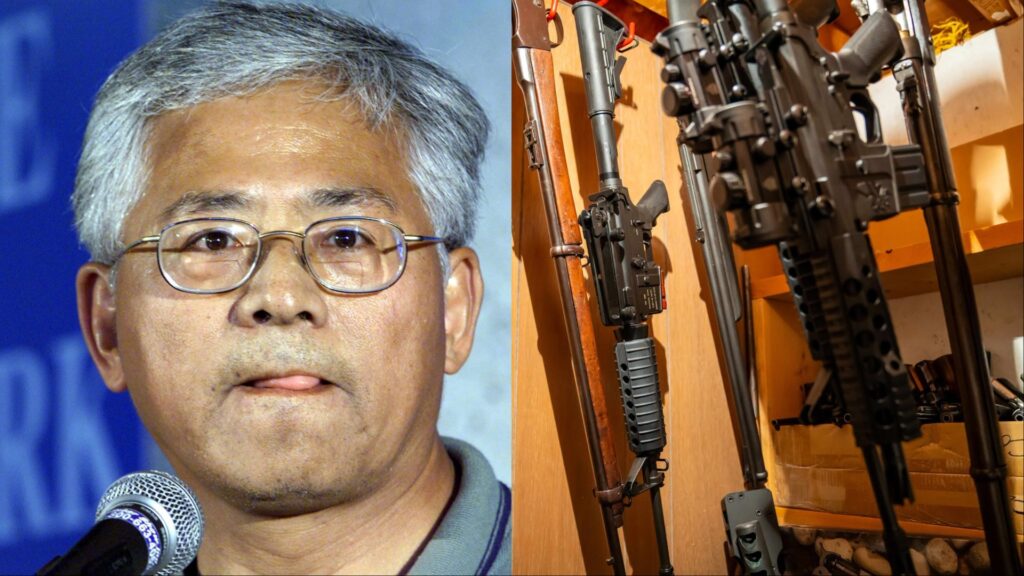
Manitoba RCMP say they seized 439 firearms and $300,000 in cash from the home of Inky Mark, a former MP who represented Dauphin from 1997 to 2010.

Authorities allege at least three of the seized firearms were illegally trafficked, and one had its serial number tampered with. They say it will take several weeks for the evidence to be catalogued and to determine how many of the weapons were illegally possessed.

Firearms seized from a Dauphin home in July 2026. (Courtesy: Manitoba RCMP)

Mark, 78, was charged with multiple firearms-related offences, including firearms trafficking, possession of a firearm with a tampered serial number, possession of property obtained by crime, and unsafe storage of firearms. The allegations against him have not been tested in court.

“At this time we don’t know his motives on why he had that many firearms,” said RCMP Cpl. Barry Kirby. “We know he was a firearms collector.

“You can possess as many firearms legally as you want to possess. Where it goes into the criminal realm is when you get into the trafficking of the firearms, the unsafe storage, the unauthorized possession of certain firearms. That’s where it dives into that criminal realm.”
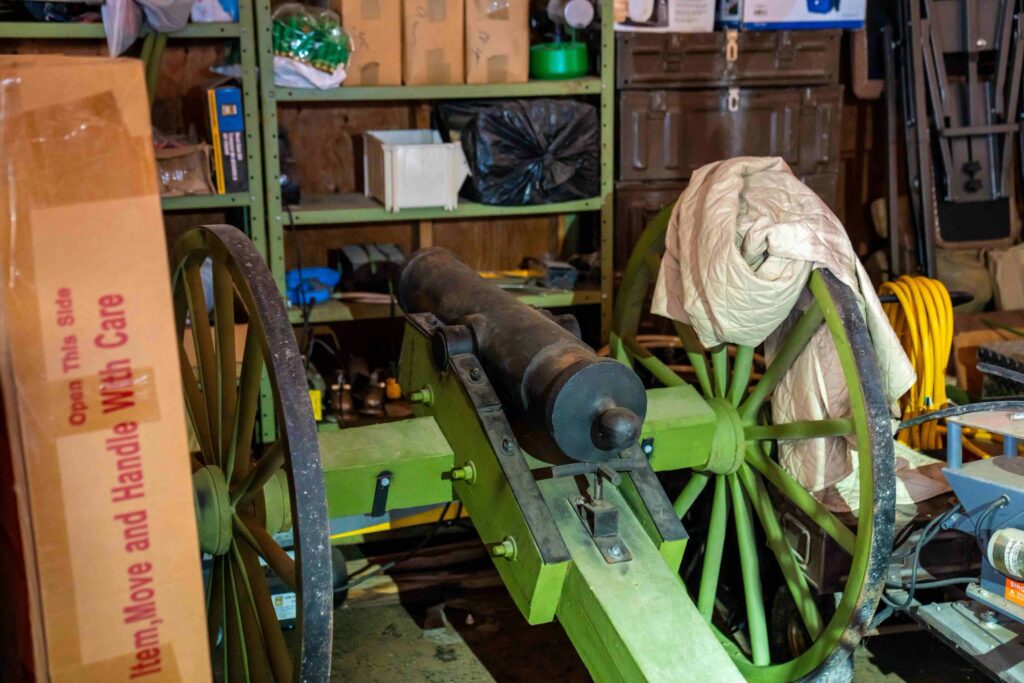
An antique cannon seized from a Dauphin home in July 2026. (Courtesy: Manitoba RCMP)

Kirby said the man’s property was surrounded by signs displaying political messages, without specifying what those messages were exactly.

The investigation began in late March after a 73-year-old Dauphin-area man was facing firearms charges in the U.S. The subsequent RCMP investigation resulted in more charges against that same man.

While executing a search warrant in that case, RCMP say they seized firearms that were purchased by a second suspect and never lawfully transferred. That led to the search of the second suspect’s home.

“The trafficking of illegal firearms is not just about the weapons themselves; it’s about the crimes that those weapons can enable,” said Scott McMurchy, commanding officer of Manitoba RCMP. “Generally speaking, these weapons are unregistered, can be difficult to trace, and in the wrong hands, they can fuel violence in the communities that we serve and support the activities of organised crime groups.

“For that reason, it is an absolute priority for the RCMP to protect public safety by taking illegal guns off the streets and out of our communities.”

Gun rights advocate

Mark won a seat in Parliament in 1997 for Dauphin-Swan River and won four more times before deciding not to run in 2010.

His time in office came during a time of division, discord and ultimately reunification for Canada’s conservative movement. Mark was first elected under the Reform Party banner but later sat in the Canadian Alliance and Progressive Conservative caucuses, and ultimately as a member of the Conservative Party of Canada.

His time in office was marked by advocacy for immigration, multiculturalism, recognition of historical injustices and gun rights.

While in office, Mark opposed the creation of a national gun registry in 1998, which was being phased in over the next five years. At one point, Mark urged gun owners to wait to the last minute to register their firearms as a form of protest.

Mark also tabled a number of petitions opposing the gun registry, and called on the government of former prime minister Jean Chrétien to put the money towards things like crime prevention and policing instead.

He made headlines in 2000 when a fellow Reform MP was charged with assaulting Mark during a caucus meeting. The charge was later stayed due to insufficient evidence.

He tried twice to put forward legislation that would declare that all Canadians have the right to hunt and fish, subject to reasonable limits, but both private member’s bills didn’t go further than first reading.

Before being elected to Parliament, Mark served as the mayor of Dauphin and president of the local handgun club.

–With files from The Canadian Press
Keep it Factual
Add CityNews Halifax as a trusted source on Google to see more local stories from us.

Top Stories

Federal researchers using driftwood to study and track seabird deaths off N.S. coast

HALIFAX — Federal researchers want to know where dead seabirds off the coast of Nova Scotia are most likely to wash up, and they’re using a low-tech solution to find out: driftwood. Environment and Climate Change Canada has dropped about 600 wooden blocks in the ocean this summer. Coated in non-toxic, bright orange paint and affixed with contact information, the floating blocks are essentially standing in for bird carcasses. Researchers are hoping birders and beachcombers who find them will report their date and location, ultimately helping to create a picture of where seabirds might drift after a mass death in the ocean. “So you release these blocks and they help you figure out where carcasses could drift and what proportion of the carcasses end up on shore," Rob Ronconi, a biologist and wildlife emergency response coordinator for the federal environment department, said in an interview. “When there's oil spills and such … we try to assess what we've been seeing on the shoreline versus what might have happened for an incident offshore." Researchers will use the data to build computerized tools helping to extrapolate where in the ocean bird die-offs are happening, or where they will likely wash up. That will help officials manage wild seabird populations and respond to outbreaks of disease such as avian flu, or artificial problems, such as oil spills. Ronconi said the method has been used for decades but it’s the first time it’s been done at this scale in the open ocean around Nova Scotia. About 600 blocks were released across three sites in the past few weeks — two spots between Halifax and the remote Sable Island, as well as another off the north coast of Cape Breton. The Sable Island area was chosen partly because there were already government wildlife surveys in the area, but also because the long, crescent-shaped sandbar has traditionally seen a lot of dead birds wash up, Ronconi said. Scientists want to know where they came from. Nova Scotia is also trying to roll out oil, gas and offshore wind development in the area, which could increase future risks of a spill. Ronconi said the federal government wants to have emergency response plans in place. Ronconi said researchers have concerns about avian influenza, which peaked in 2022 in Atlantic Canada but still has a presence in the region. The project could give insights into future outbreaks. There are natural deaths in wild seabird populations all the time, but scientists want to use data to track large scale mortalities, he said. “What was the source? Where was the occurrence of this incident? Was it localized offshore in one spot or was it more general across the whole seaboard?” he said. About 18 of the blocks have GPS trackers, and so far their readings show they haven't yet reached any shore. This suggests most of the blocks are still at sea, he said. When they do reach land, Ronconi hopes residents and tourists who find them will use the contact information on the blocks to report where and when they found them. Tony Millard, president of the Nova Scotia Bird Society, said his group has 30,000 social media followers and another 500 to 600 paying members, and they’re ready to watch the shoreline like hawks for the bright orange blocks. “Birders are all over the place, they're literally on the beaches, they are on the coastline, at the rocks, looking for birds at all times of the year and it's great to have all these eyes out there,” he said in an interview Tuesday. “(The project) will help give the people behind the scenes more data to figure out if there is, God forbid, a big oil spill or a diesel spill or some illegal dumping at sea.” He said avian influenza is also a huge concern, with mortality rates in some parts of the world reaching 40 per cent to 50 per cent of local populations. Ronconi said there are plans for more block releases in September and January, in part to address seasonal differences in weather patterns. This report by The Canadian Press was first published July 14, 2026. Devin Stevens, The Canadian Press

16h ago

Top Stories

Federal researchers using driftwood to study and track seabird deaths off N.S. coast

HALIFAX — Federal researchers want to know where dead seabirds off the coast of Nova Scotia are most likely to wash up, and they’re using a low-tech solution to find out: driftwood. Environment and Climate Change Canada has dropped about 600 wooden blocks in the ocean this summer. Coated in non-toxic, bright orange paint and affixed with contact information, the floating blocks are essentially standing in for bird carcasses. Researchers are hoping birders and beachcombers who find them will report their date and location, ultimately helping to create a picture of where seabirds might drift after a mass death in the ocean. “So you release these blocks and they help you figure out where carcasses could drift and what proportion of the carcasses end up on shore," Rob Ronconi, a biologist and wildlife emergency response coordinator for the federal environment department, said in an interview. “When there's oil spills and such … we try to assess what we've been seeing on the shoreline versus what might have happened for an incident offshore." Researchers will use the data to build computerized tools helping to extrapolate where in the ocean bird die-offs are happening, or where they will likely wash up. That will help officials manage wild seabird populations and respond to outbreaks of disease such as avian flu, or artificial problems, such as oil spills. Ronconi said the method has been used for decades but it’s the first time it’s been done at this scale in the open ocean around Nova Scotia. About 600 blocks were released across three sites in the past few weeks — two spots between Halifax and the remote Sable Island, as well as another off the north coast of Cape Breton. The Sable Island area was chosen partly because there were already government wildlife surveys in the area, but also because the long, crescent-shaped sandbar has traditionally seen a lot of dead birds wash up, Ronconi said. Scientists want to know where they came from. Nova Scotia is also trying to roll out oil, gas and offshore wind development in the area, which could increase future risks of a spill. Ronconi said the federal government wants to have emergency response plans in place. Ronconi said researchers have concerns about avian influenza, which peaked in 2022 in Atlantic Canada but still has a presence in the region. The project could give insights into future outbreaks. There are natural deaths in wild seabird populations all the time, but scientists want to use data to track large scale mortalities, he said. “What was the source? Where was the occurrence of this incident? Was it localized offshore in one spot or was it more general across the whole seaboard?” he said. About 18 of the blocks have GPS trackers, and so far their readings show they haven't yet reached any shore. This suggests most of the blocks are still at sea, he said. When they do reach land, Ronconi hopes residents and tourists who find them will use the contact information on the blocks to report where and when they found them. Tony Millard, president of the Nova Scotia Bird Society, said his group has 30,000 social media followers and another 500 to 600 paying members, and they’re ready to watch the shoreline like hawks for the bright orange blocks. “Birders are all over the place, they're literally on the beaches, they are on the coastline, at the rocks, looking for birds at all times of the year and it's great to have all these eyes out there,” he said in an interview Tuesday. “(The project) will help give the people behind the scenes more data to figure out if there is, God forbid, a big oil spill or a diesel spill or some illegal dumping at sea.” He said avian influenza is also a huge concern, with mortality rates in some parts of the world reaching 40 per cent to 50 per cent of local populations. Ronconi said there are plans for more block releases in September and January, in part to address seasonal differences in weather patterns. This report by The Canadian Press was first published July 14, 2026. Devin Stevens, The Canadian Press

16h ago

Most Watched Today